24 hour Emergency Service
Se habla español

Drain Field Inspections

Serving King County WA

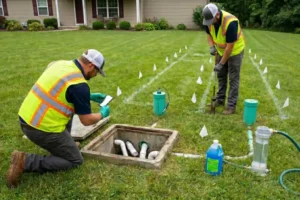
Drain Field inspection in a yard. Call Puget Sound Septic to have your drain field inspected today.Does your property rely on a residential septic system? Then it features a drain field—also commonly referred to as a leach field. Even though this component operates without mechanical parts, it is arguably the most critical element of your entire On-Site Sewage System (OSS). Keeping your soil absorption area in optimal condition is crucial for avoiding catastrophic system failure and costly environmental hazards. That’s where routine drain field inspections and professional septic maintenance come in.

At Puget Sound Septic, we deliver certified septic drain field inspection services in the Seattle Area and King County, WA. Our comprehensive leach field evaluations are engineered to protect your investment, maintain compliance with local public health regulations, and grant you complete peace of mind. Call our licensed septic specialists today to schedule your site assessment.

How Often Should You Schedule a Septic Drain Field Inspection? 

Because the soil absorption field handles all final effluent treatment, routine drain field testing is essential for catching bio-mat accumulation, hydraulic overload, or structural degradation early.

  • Gravity Septic Systems: The leach field must undergo a physical evaluation at least once every three years.
  • Alternative & Pressure-Distribution Systems: Requires professional inspection at least once every year (including mound systems, sand filters, and pump chambers).

Proactive maintenance for your septic system is your single best defense against expensive leach field failure, emergency backups, and costly excavation work. Investing in routine performance monitoring today saves you thousands in premature system replacement down the road.

What’s Included in Our Comprehensive Drain Field Inspections?

While basic septic checkups often skip in-depth soil testing, Puget Sound Septic includes high-level diagnostic assessments as part of our full-service septic inspections.

  • Visual Surface Assessment: Scanning the absorption field for spongy lawn conditions, standing wastewater, sluggish turf growth, or surface sewage odors.
  • Distribution Box (D-Box) Inspection: Verifying that septic tank effluent is distributing evenly across all lateral lines and inspecting for sludge migration or structural wear.
  • Inspection Port Monitoring: Measuring standing liquid levels and bio-layer buildup within PVC access pipes across the leach line network.
  • Soil Probing & Core Boring: Testing soil saturation levels, percolation capability, and identifying excessive biomat growth along the trench bottom.
  • Hydraulic Load & Stress Testing: Running controlled water volume surges through the system to evaluate real-time leach field absorption capacity and drain recovery.
  • Fluorescent Dye Testing: Tracing effluent pathways to detect concealed leaks, surfacing wastewater, or direct cross-contamination.
  • Component Integrity Check: Locating crushed distribution pipes, soil compaction, or invasive root intrusion blocking proper wastewater flow.

What Can You Expect During Your Drain Field Inspection?

If it’s been several years since your last leach field checkup, here is what you can expect during our site visit:

  1. Homeowner Preparation: Note any history of sluggish drains, plumbing backups, or unusual water usage patterns. Clear any overgrown brush, and ensure no heavy vehicles or temporary structures are parked near the leach field access ports.
  2. Hydraulic Load Testing: To evaluate real-time soil absorption and drain recovery, your technician may perform a standard hydraulic load test during the site visit. By running a controlled dose of water—typically 100 to 300 gallons over a 1-to-2-hour window—we simulate peak household water usage while actively monitoring liquid levels at the distribution box and inspection ports. This single-visit stress test allows us to verify whether your soil absorption system disperses wastewater efficiently without backing up or ponding. Even subtle liquid accumulation during this test indicates restricted soil percolation or early-stage biomat restriction.
  3. Record Keeping & Compliance: We log all inspection results into King County health department databases. Storing these records securely protects your property value and ensures seamless documentation for future real estate transactions.

How to Locate Your Septic Drain Field

The drain field acts as the final purification stage of your septic infrastructure. When operating correctly, it safely and evenly filters clarified wastewater back into the natural water table.

Drain fields are typically situated in open, unobstructed lawn areas downstream from your septic tank and pump basin lids. However, pinpointing exact trench layouts can be challenging. If you are unsure of your system footprint, you can:

  • Contact your original septic tank installer or designer.
  • Request official as-built property records from Public Health – Seattle & King County.
  • Trace main sewer pipe exits from your home’s foundation.
  • Hire our team to perform electronic pipe locating and ground-penetrating site mapping.

Drain Field Inspection FAQs

Long before sewage backs up into your home or pools on your lawn, subtle early warning indicators appear:

  • Slightly Sluggish Drains: Fixtures in the lowest level of the home (like a basement shower) drain noticeably slower than usual, often accompanied by faint gurgling sounds.
  • Spongy Lawn Conditions: The grass directly above the absorption trenches feels unusually soft or springy underfoot compared to the rest of the yard.
  • Hyper-Greener Grass: Distinct, lush green stripes appear across your lawn along the exact footprint of the underground lateral lines.
  • Transient Odors: Faint, sporadic sewer gas smells drift around the yard on warm, humid, or low-wind days. Plumbing
  • Backup During Peak Usage: Drains back up only when running multiple water-heavy appliances simultaneously (e.g., running the dishwasher while doing laundry).

King County’s heavy rain season directly affects drain field performance and testing dynamics:

  • Hydraulic Overload: Protracted rainfall raises the local groundwater table. Saturated surrounding soil reduces the ground’s capacity to absorb effluent from the system, temporarily slowing down field recovery times.
  • False Reading Risks: Standard soil probing during wet winter months can mimic a failing system because the soil is already saturated by rainwater.
  • Inspection Scheduling: Technicians must measure both baseline groundwater levels and system effluent levels to distinguish between external stormwater saturation and internal system blockage.
  • Mitigation Measures: Maintaining functioning perimeter drains (curtain drains) and keeping gutters diverted away from the leach field are critical during PNW winters to prevent surface runoff from drowning the absorption area.

If a drain field fails inspection in King County, WA, specific regulatory and operational steps follow:

Phase What Happens
Official Logging The inspector submits an official non-compliant status report to Public Health – Seattle & King County.
Real Estate Impact If the property is listed for sale, the failed status must be disclosed. Most lenders will pause mortgage approval until a resolution or escrow holdback is established.
Corrective Action Plan You must hire a licensed On-Site Sewage System (OSS) designer to draft a repair or replacement proposal.
Permitting & Sign-Off King County Health reviews the repair plan, issues necessary permits, and re-inspects the property after authorized work is completed to update the system back to compliant status.

Full excavation is not always necessary. When caught early, non-destructive restoration options include:

  • High-Pressure Lateral Hydro-Jetting: Inserting specialized self-propelling nozzles into the distribution lines to scrub away accumulated bio-sludge and scale without digging up pipes.
  • Terralift Soil Fracturing: A specialized machine drives a narrow probe beneath the trench bed and delivers high-pressure air bursts to fracture compacted soil. Polystyrene beads are injected into the newly created fissures to keep the pathways open for drainage.
  • Aerobic Bacterial Inoculation: Introducing concentrated aerobic bacteria into the distribution network to break down and digest organic bio-mat buildup.
  • System Rest Cycles: Temporarily diverting effluent using a distribution valve (if a split drain field exists) gives the saturated side time to naturally dry out and break down biomat.

A percolation test measures the natural soil absorption rate before a system is ever installed, whereas a hydraulic load test measures the recovery rate of an existing system under stressed operating conditions.

Feature Percolation (Perc) Test Hydraulic Load Test (HLT)
Primary Purpose Determines if undisturbed soil can absorb water to design a new system. Evaluates if an existing operational system can handle real-world peak water volume.
When Performed Before building a home or adding a new drain field. During routine diagnostic checkups or real estate transfer inspections.
Test Execution Holes are bored into raw earth, filled with water, and drop rates are timed over several hours. A controlled volume of water (100–300 gallons) is introduced directly into the existing network.
Key Metric Minutes per inch of water drop (percolation rate). Real-time liquid drop/recovery rate during the 1-2 hour test window 

Not necessarily. A failed or compromised drain field inspection does not automatically mean you are facing a complete, costly system replacement. Many issues are caused by localized line blockages, crushed distribution pipes, temporary hydraulic overload, or minor biomat buildup—problems that can often be resolved through targeted repairs, line hydro-jetting, or specialized soil fracturing (Terralift).

If your inspection reveals an issue, Puget Sound Septic guides you through every step of the recovery process:

  • Accurate Diagnostics: We pinpoint the exact cause and location of the failure so you never pay for unnecessary work.
  • Turnkey Repair & Remediation: From high-pressure line cleaning to component replacement, we handle the corrective work efficiently.
  • Permitting & Agency Coordination: We navigate the paperwork with Public Health – Seattle & King County, securing required permits and filing updated compliance reports on your behalf to restore your system to fully compliant status.

While both issues cause surface moisture and plumbing disruptions, key diagnostic clues can help you distinguish between a main sewer line break and a leach field failure:

  • Location of the Problem: A broken main line typically causes localized soggy spots, sinkholes, or sewage smells close to the foundation wall or directly along the pipe path between the house and the septic tank. A failing drain field shows symptoms farther downstream, directly over or around the absorption trenches.
  • Effluent Appearance & Odor: A severed or cracked transport pipe often creates sudden, concentrated pooling or localized structural soil erosion. A saturated or clogged drain field produces widespread, spongy soil, dark sluggish effluent surfacing across multiple lines, or lush green striping across the entire lawn footprint.
  • Plumbing System Response: A clean break in a sewer pipe often causes immediate, total plumbing stoppage or backup into low-level home drains regardless of overall water volume. A failing drain field typically manifests as gradual sluggishness that worsens during peak usage periods (like running laundry or taking back-to-back showers).
  • Diagnostic Verification: During an inspection, technicians introduce fluorescent dye into the plumbing network or conduct video camera line inspections. If dye surfaces along the pipe pathway or a camera reveals crushed PVC prior to the tank, it’s a pipe break. If dye surfaces throughout the trench network during a hydraulic load test, the drain field is saturated or biomat-restricted.

While homeowners can perform basic visual checkups between scheduled maintenance intervals, a DIY check cannot replace a comprehensive, certified inspection. Here is what you can safely check on your own versus when you need to call a licensed specialist:

What You Can Check Yourself (Visual DIY Checks):

  • Surface Moisture & Lawn Turf: Walk your leach field footprint monthly to check for soggy spots, standing water, or unusually lush, bright green grass over the trenches.
  • Odor Monitoring: Take note of persistent or recurring sewage smells around the absorption area or septic tank lids.
  • Home Plumbing Symptoms: Keep an eye out for sluggish drains, gurgling toilets, or water backing up when running high-volume appliances like washing machines.
  • Clear Clearance Zones: Ensure no trees, deep-rooted shrubs, heavy vehicles, or livestock are encroaching on the drain field area, and verify that roof gutters divert runoff away from the leach field.

When to Call a Licensed Professional:

  • Regulatory & Time of Sale Compliance: King County mandates certified O&M inspections (every 3 years for gravity, annually for alternative systems). DIY checks do not satisfy county health department reporting or real estate transfer requirements.
  • Sub-Surface & Diagnostic Testing: Opening inspection ports, core soil probing, measuring biomat depth, checking D-box effluent distribution, or running hydraulic load tests require specialized equipment, safety gear, and professional training.
  • Active System Distress: If you notice surfacing sewage, sewage odors inside the home, or widespread plumbing backups, contact a certified septic specialist immediately to prevent total system failure and severe soil contamination.

Get an Expert Opinion on Your Leach Field Today

Don’t wait until you’re struggling with an issue – drain field and leach field repairs are often expensive. Keep your system regularly inspected and maintained so every piece, including your drain field, can work smoothly.

Reach out to Puget Sound Septic today to get a comprehensive inspection for your property.